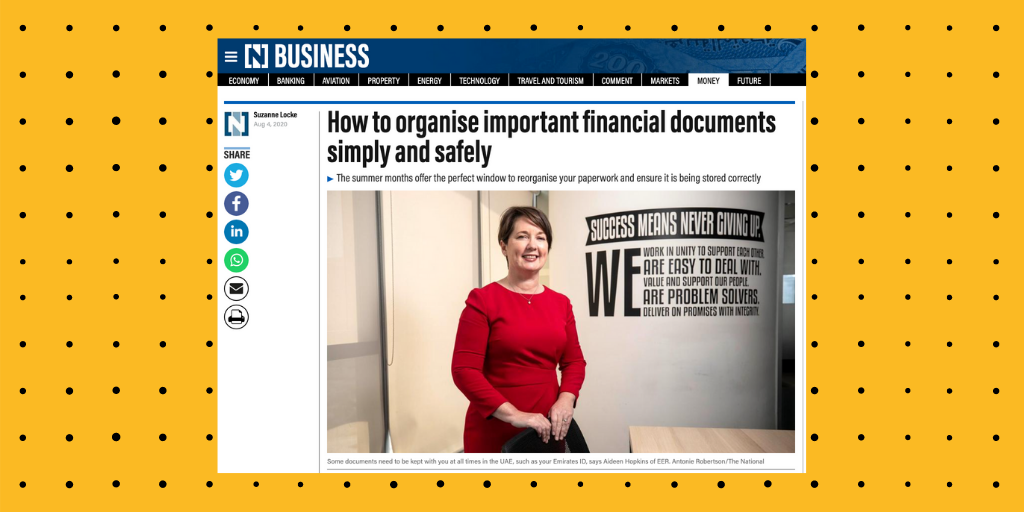
Get your paperwork organised and learn how to stay on top of it – plus the documents you need to hold onto as a UAE expat.
Top document organisation tips
- Get a fire-proof safe, scan, file electronically, shred and use a cloud service for security – plus password protection on files.
- Don’t use plastic sheet protectors for important documents, as they stick to the document and remove the ink after some time.
- File documents in a ring binder by punching the holes into the empty envelopes first – not once those important documents are inside.
The general rule of thumb for personal finance documents is to keep the original for at least at least five years and then to archive them for a further three.
Financial documents to keep forever:
- Title deeds, property records, mortgages and bills of sale
- Life insurance paperwork
- Passports, birth, marriage and death certificates
- Share and bond certificates
Financial documents you should keep for one to 10 years:
- Home, medical and motor insurance policies – 10 years from expiry is the usual requirement – retain digitally after one year unless a claim has to be made under the policy
- Signed contracts – seven years from date of expiry
- Accident reports and claims – seven years from date of settlement
- Medical reports – seven years
- Sales receipts and warranties for major purchases, such as cars, furniture or appliances – seven years after sale of asset, in case of future insurance claims
- Business tax returns and overseas tax returns – three to six years
- Utility bills – one year
- Bank statements – one year
UAE-specific issues with financial documents
- For all residents: Passport and passport photos; an attested education certificate (only in its original form or the certified copy); certified birth and marriage certificates; health insurance; UAE residency; Emirates ID (original or copies of both front and back); driver’s licence; your signed lease agreement and its subsequent Ejari (for Dubai) or Tawtheeq (for Abu Dhabi) tenancy registration; and any receipt for a security deposit – for instance from your utility company.
- To keep to hand at all times: Emirates ID and your driving licence, and a copy of your car registration card, as this is now done electronically.
- When moving to the UAE: Attested education certificate, birth and marriage certificates.
- When leaving the UAE: Clearance or “no liability” letters, police clearance certificate if needed (before you cancel your visa); transfer certificates from your children’s schools; copies of your medical records; visa cancellation papers; and an immigration printout showing entry and exit from the UAE plus a certified bank statement for tax domicile certificates.
Originally written for The National and published in August 2020.